Contents
Overview of Clinical-track Decision-making Procedures
Promotion Decision Making Procedures
- Department level procedures
- DEO's responsibility
- The Dossier
- Candidate's responsibility
- Internal peer evaluation–teaching
- Internal peer evaluation–professional productivity
- Internal peer evaluation–clinical and other service
- External peer evaluation–professional productivity and/or clinical and other service
- Opportunity to respond to internal peer evaluations
- DCG participation
- DEO participation
- Opportunity to respond to DEO
- College level procedures
- University level procedure
Appendix A—Points to be Determined by Collegiate Procedures
Appendix B—Recommendation for Faculty Promotion Cover Sheet
Appendix D—Comments on the Procedures
Appendix E—Review Procedures for Instructional-track Faculty with Joint Appointments
[top]
Provost's final draft 3-31-01
Ad hoc committee final draft 2-17-03
Approved, University of Iowa Faculty Council 2-25-03
Approved, University of Iowa Faculty Senate 3-4-03
Revision approved, University of Iowa Faculty Council 8-24-04
Revision approved, University of Iowa Faculty Senate 9-07-04
Policy Manual links updated, Office of the Provost 3-18-26
General Principles
General Principles
The Procedures for Clinical-Track Promotion Decision Making (hereafter “Procedures”) establish a uniform system of procedures to be used in all academic units of the University. Each college of the University that employs clinical-track faculty also will establish its own written Procedures governing its promotion decision making for salaried clinical-track faculty, to guide academic units when circumstances require or permit flexibility or variation. (For a list of items in these Procedures that specifically require that Collegiate Policies be followed, see Appendix A.) The Provost must approve all Collegiate Procedures.
These are procedures only. For University policies regarding criteria for promotion of clinical-track faculty, refer to section III-10.6(1) of the Policy Manual; The substantive standards contained therein must be satisfied and are not affected by these Procedures.
These Procedures rely upon several principles:
- Decisions granting or denying promotion should be based on a written record of achievement.
- The content of the record that will be relied upon should be known by the candidate and the decision makers, except as otherwise provided for in these Procedures.
- Except for variation related to the nature of the candidate’s academic activity, the content of the record should be the same for all candidates in the same academic unit.
- The governing procedures should be the same for all candidates across the University, except where conditions or academic cultures justify variation among colleges or among departments within a college.
- University and Collegiate Procedures should be applied consistently to all candidates.
- Each faculty member participating in the promotion decision-making process may do so at only one level of the process: departmental, collegiate, or provostial. Faculty with collegiate or provostial administrative appointments of 50% or greater shall participate in their administrative office, except in rare and special circumstances at the discretion of the Provost.
I. Definitions
The term “professional productivity” refers to professional works and activities as described in section I.B.(3)(d)ii—I.B.(3)(d)vii of these Procedures.
A “candidate” is any salaried clinical-track faculty member who has indicated his or her interest in being reviewed for promotion in accordance with the college’s written Procedures governing promotion decision making.
The “dossier” is the set of primary materials assembled by the candidate as described in section I.B.(3). The dossier contains appendices all or part of which may be transmitted with the dossier to successive participants in the process as described in section I.B.(4).
The “Promotion Record” is the dossier plus all of the materials that are added to it and transmitted to successive participants in the evaluation process.
The “Departmental Consulting Group” (DCG) consists of all tenured, tenure-track, and clinical-track faculty at or above the rank being sought by the candidate, excluding the collegiate Dean and Provost, faculty with collegiate or provostial administrative appointments of 50% or greater, and any faculty member with a disqualifying conflict of interest. If there are fewer than four eligible faculty and/or if there are no eligible clinical-track faculty to serve as the DCG, the Dean, in consultation with the eligible faculty, will identify additional faculty outside the department so that the DCG consists of a minimum of four faculty and has clinical-track faculty representation. The college’s written Procedures governing promotion decision making also may specify further the composition of the DCG to include additional clinical-track faculty from outside the department.
The “Collegiate Consulting Group” (CCG) consists of faculty selected according to each college’s written Procedures governing promotion decision making. The Collegiate Procedures shall establish guidelines for the membership of the Group and how it will function within the boundaries of these Procedures.
The term "Departmental Executive Officer" or “DEO” throughout the Procedures refers to the person or entity who has been expressly designated by the college (in the college’s written Procedures governing promotion decision making) to perform one or more of the functions assigned by these Procedures to the DEO. Under this definition, each college has discretion, through the college’s written Procedures governing promotion decision making, to determine who will be given responsibility to perform any of the functions assigned to the DEO by these Procedures. In a non-departmentalized college (where "departmental" generally means "collegiate" and "functions of the DEO" ordinarily means functions of the collegiate Dean), the college has exactly the same discretion through its written Procedures governing promotion decision making to determine who will be given the responsibility to perform the functions assigned by these Procedures to the Dean in lieu of the DEO.
In non-departmentalized colleges, the term “departmental” throughout these Procedures will ordinarily mean “collegiate” where that substitute usage fits the context, and the functions of the DEO will be performed by the collegiate Dean. (Some steps of these Procedures that expressly involve the DEO will become inapplicable.) In non-departmentalized colleges that have department-like units such as “areas” or “divisions,” the written Collegiate Procedures governing promotion decision making must specify the role of these units and their administrative officers for the purposes of promotion decision making.
“Participate” means to have input into a promotion decision, including but not limited to such activities as preparing a written report or review of the candidate’s work, participating in a formal discussion of the candidate’s qualifications, voting on a recommendation for or against promotion, or providing consultation except as provided for elsewhere in these procedures.
II. Basis for Evaluation: The Promotion Record
The qualifications of a candidate for promotion will be determined on the basis of the Promotion Record, which, when it reaches the Office of the Provost, will consist of the following material preferably in the order listed:
- the "Recommendation for Faculty Promotion" cover sheet (see Appendix B);
- the collegiate Dean's letter making a recommendation to the Provost;
- the recommendation and vote (and report, if any) of the CCG;
- the DEO's letter making a recommendation to the Dean;
- the recommendation, vote and report of the DCG;
- any letters or written response submitted by the candidate at specified stages of the process to correct errors in the internal peer evaluations of the candidate's teaching, professional productivity, and service, or to respond to a letter or report of the DEO, DCG, Dean, or CCG;
- the candidate's Curriculum Vitae (CV) in the college's standard format which documents the candidate's educational and professional history;
- a section on the candidate's teaching, including
- the candidate's personal statement on teaching,
- documentation of peer evaluation of the candidate's teaching, and
- all other materials related to the candidate's teaching, including those specified in I.B.(3)(c);
- a section on the candidate's professional productivity, including
- the candidate's personal statement on professional productivity,
- documentation of internal and external peer evaluation of the candidate's professional productivity, and
- all other materials related to the candidate's professional productivity, including those specified in I.B.(3)(d);
- a section on the candidate's clinical and other service, including
- the candidate's personal statement on service,
- documentation of internal and external peer evaluation of the candidate's service, and
- all other materials related to the candidate's service, including those specified in I.B.(3)(e); and
- supplementary material to be added to the Promotion Record as expressly provided in these or Collegiate Procedures, entered in the appropriate section of the Record. Materials added to the original dossier or materials in the original dossier that are amended, should be labeled as such, including the date when added or amended and with amendments clearly marked.
III. Other Considerations
A candidate has the right to withdraw his or her dossier from further consideration at any point before the Provost has made his/her final decision regarding promotion. If a candidate withdraws his or her dossier from further consideration, the original dossier, including appendices and any supplemental materials added by the candidate, shall be returned to the candidate. All other materials in the Promotion Record at the time of withdrawal shall be returned to the candidate's department, which shall retain them following the normal departmental or collegiate schedule for retention of promotion materials. The candidate shall not have access to these materials.
A college, or department with the concurrence of its college, may apply in individual cases to the Provost for an exemption from any of these Procedures for a legitimate and valid reason. The college or department has the burden of convincing the Provost that the exemption adds value, fairness and weight to the evaluation.
In the case of a joint-appointment candidacy for promotion, the departments involved will follow the Procedures described in Appendix E of this document.
These Procedures apply to clinical-track faculty only.
[top]
Overview of Clinical-track Promotion Decision-making Procedures
Overview of Tenure and Promotion Decision-making Procedure
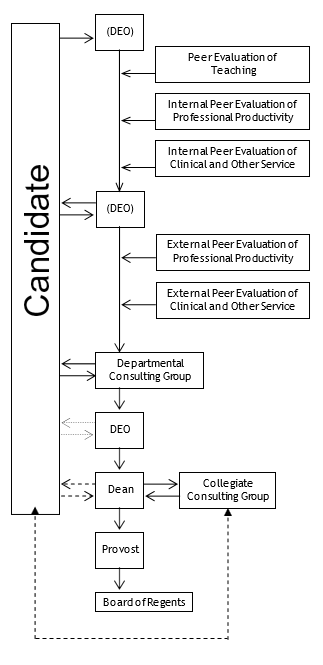
Sequential Development of Promotion Record through Decision-Makers:
- Candidate and DEO compile dossier
- Peer evaluation of teaching
- Internal peer evaluation of professional productivity
- Internal peer evaluation of clinical and other service
- Candidate's opportunity to respond
- External peer evaluation of professional productivity
- External peer evaluation of clinical and other service
- Departmental Consulting Group's vote and report
- Candidate's opportunity to respond
- DEO's letter to Dean
- Candidate's opportunity to respond, if DEO's recommendation is negative
- Collegiate Consulting Group's vote and summary report, if any*
- Candidate's opportunity to respond*
- Dean's letter to Provost
- Candidate's opportunity to respond, if Dean's recommendation is negative
- Provost's recommendation to the Board of Regents
*If recommendation is negative and contrary to DEO or DCG recommendation
[top]
I. Department level procedures
A. DEO's responsibility
- It is the DEO's responsibility to inform the candidate in writing in the year of appointment to a salaried clinical track position, in the year of any contract renewal, and at the beginning of the academic year in which the promotion decision will be made of the material that is required to be included in the promotion dossier, and of the candidate's responsibility to compile and submit the dossier by the specified date in the academic year of the promotion decision.
B. The Dossier
- The Dossier
- It is the candidate's responsibility, with the advice of the DEO, to compile and submit substantive material for inclusion in the promotion dossier (the core of the Promotion Record) on or before the date specified in the college's written Procedures governing promotion decision making. In the absence of such a specified date in the college's written Procedures, the specified date will be September 1 of the academic year in which the promotion decision is to be made.
- It is the responsibility of the DEO to advise the candidate in compiling material for the dossier, to complete the compilation of the dossier (and subsequently to complete compilation of the Promotion Record by adding materials to it throughout the decision-making process), and to ensure to the greatest extent possible that the Promotion Record serves as a fair and accurate evaluation of the candidate's strengths and weaknesses, and is not purely a record of advocacy for the candidate. The responsibility to advise the candidate in compiling the dossier material is not limited to the immediate period of the promotion review, but rather is an ongoing responsibility that begins when the faculty member is appointed to the department.
- The dossier will contain the following, in the order listed unless otherwise noted. A current CV in the college's standard format may be used in place of the individual items listed below, provided that either all the listed elements are contained in the CV or any missing elements are supplied separately.
- the "Recommendation for Faculty Promotion" cover sheet, with the section that is to be filled out by the candidate completed (see Appendix B);
- a record of the candidate's educational and professional history (C.V.), including at least the following sections, preferably in the order listed:
- a list of institutions of higher education attended, preferably from most to least recent, indicating for each one the name of the institution, dates attended, field of study, degree obtained, and date the degree was awarded;
- a list of professional and academic positions held, preferably from most to least recent, indicating for each one the title of the position, the dates of service, and the location or institution at which the position was held; and
- a list of honors, awards, recognitions, and outstanding achievements, preferably from most to least recent.
- a record of the candidate's teaching at the University of Iowa, including:
- the candidate's personal statement on teaching, consisting of a summary and explanation—normally not to exceed three pages—of the candidate's accomplishments and future plans concerning teaching, and comments on these accomplishments and plans and on other items included in the dossier related to teaching;
- a list of the candidate's clinical teaching as it occurs in the context of the delivery of professional services to individuals, patients or clients, preferably from most to least recent;
- a list of the candidate's teaching assignments on a semester-by-semester basis, preferably from most to least recent;
- a list of graduate students, fellows, or other postdoctoral students supervised, if any, including each student's name, degree objective, and first post-graduate position;
- a list of residents for whom the faculty member has provided substantial and prolonged supervision throughout all or most of their training program, including each student's name and first post-residency position;
- a list of other contributions to instructional programs;
- copies of course materials, including syllabi, instructional Web pages, computer laboratory materials, and so forth (see I.B.4); and
- as an appendix to the dossier, copies of teaching evaluations by students (the candidate will include all student teaching evaluations in her or his custody for each course taught);
a record of the candidate's professional productivity, including:
- the candidate's personal statement on professional productivity consisting of a summary and explanation—normally not to exceed three pages—of the candidate's accomplishments and future plans concerning professional productivity, and comments on these accomplishments and plans and on other items included in the dossier related to professional productivity;
- a list of invited lectures and conference presentations;
- a list of conferences for which the candidate has organized symposia, workshops, and so forth;
- a list of journals for which the candidate has been a member of the editorial board or served as editor;
- a list, preferably from most to least recent, of the candidate's publications or creative works with, for each multi-authored work or coherent series of multi-authored works, a brief statement of the candidate's contribution to the work or series of works;
- a list of attained support including grants and contracts received by the candidate;
- a description of any other products and activities demonstrating professional productivity as defined by the college's written Procedures on promotion decision making;
- a list of pending decisions regarding the candidate's professional productivity that might affect the promotion deliberations; and
- as an appendix to the dossier, copies of materials documenting the candidate's professional productivity.
Research or creative scholarship is not required for promotion on the clinical track; however, publications, grants, and other types of research and creative activity may provide evidence of professional productivity.
- a record of the candidate's clinical and other service to the department, college, university, profession, and community, including:
- the candidate's personal statement on service including both their clinical service and other types of service (consisting of a summary and explanation—normally not to exceed three pages—of the candidate's accomplishments and future plans concerning clinical service and other service, and comments on these accomplishments and plans and on other items included in the dossier related to clinical and other service);
- a list, preferably from most to least recent, of clinical service activities in each of the years since the last promotion;
- a list, preferably from most to least recent, of other departmental, collegiate, or university service positions;
- a list, preferably from most to least recent, of relevant community involvement;
- a list, preferably from most to least recent, of offices held in professional organizations;
- a list, preferably from most to least recent, of service on review panels; and
- a list, preferably from most to least recent, of any service contributions not listed elsewhere.
- within the appropriate section(s) of the dossier as listed above, other information relevant to the candidate's record in teaching, professional productivity, or clinical or other service that is deemed to be important in the candidate's judgment or required by the college's written Procedures governing promotion decision making.
- Where the volume of material of a particular kind which is required to be included in the dossier is large and potentially unmanageable, a candidate, in consultation with the DEO, may select and identify representative portions of the required material for special attention. Only the material selected as representative will become part of the Promotion Record and will be transmitted to successive participants in the promotion decision-making process. Required materials segregated from the representative material will be available for review and will be located in a readily accessible location under the DEO's custody. If any participant in the promotion decision-making process relies upon initially segregated material in preparing a written evaluation of the candidate's qualifications, that material should be added to the Promotion Record, the fact of that addition should be noted in the written evaluation, and the candidate should be notified in writing of the addition at the time it is made.
- The candidate's work in progress that is not completed by the specified date but that is anticipated to be completed in the fall—early enough for full and deliberate evaluation, as determined by the DEO—may be identified at the time the dossier is submitted and added to the dossier if and when it is completed.
- Other materials (including updated CVs and personal statements) that could not have been available by the specified date but which are completed early enough for full and deliberate evaluation may be added to the promotion dossier by the candidate through the DEO. Materials added to the original dossier or materials in the original dossier that are amended, should be labeled as such, including the date when added or amended and with any amendments clearly marked.
C. Candidate's responsibility
- It is the candidate's responsibility to cooperate in obtaining peer evaluations of the candidate's teaching, professional productivity, and clinical and other service as described in the following sections, D.—F. Each college will specify in its written Procedures governing promotion decision making whether these peer evaluations will be carried out by individual members of the department, by one or more faculty committees, by other peers, or by some combination of these methods, as well as what process the reviewers will follow. These peer evaluations of the candidate's teaching, professional productivity, and clinical and other service will be contained in one or more reports that analyze the relevant materials in the Promotion Record as detailed in the respective sections that follow, and shall be signed by each peer evaluator. These reports are intended to go beyond a mere description of what the candidate has included in the dossier and provide a thorough evaluation of the quantity and quality of the candidate's teaching, research, and service from a departmental perspective.
D. Internal peer evaluation-teaching
- It is the candidate's responsibility to cooperate in obtaining internal peer evaluation of the candidate's teaching by participating in the following process:
- The college's written Procedures governing promotion decision making must specify a method of peer evaluation of teaching—which must include peer observation of teaching to the extent practicable—and must identify those teaching activities and materials that will be evaluated by peers. The method chosen must, where necessary, contemplate and address teaching that occurs in a privileged setting. Each college will specify in its written Procedures governing promotion decision making who will perform these peer evaluations of teaching. In circumstances when the observation cannot be made entirely by faculty peers, the candidate must receive written approval from the Provost for the selection of non-faculty peer reviewers and they can constitute only a minority of the evaluations specified by Collegiate Procedures. The request for approval must be justified by and contained in a written request from the Dean.
- With respect to the observation of classroom, laboratory, practicum, or other forms of teaching, the college's written Procedures governing promotion decision making will specify the number (or range of numbers) of teaching occasions to observe; the number (or range of numbers) of consecutive semesters in which observations will occur; the number (or range of numbers) of observing faculty members or other peers; the method of choosing faculty or other peer observers; the method of recording, reporting, and informing the candidate of the observation; the method(s) by which the quality of the candidate's teaching will be measured, and any other protocol concerning the observation process.
- In the evaluation of teaching that involves the peer observation of teaching activities, the college's written Procedures governing promotion decision making will provide for:
- consistent treatment of candidates;
- an adequate basis for fair evaluation; and
- avoidance of an undue burden on either the observed candidate or the observing faculty or peers or an undue disruption of any observed class or other teaching situation.
- If expressly authorized by the college's written Procedures governing promotion decision making, video observation that is consistent with the substance of this section may be substituted for actual observation of a teaching activity with the candidate's consent.
- The DEO will add to the appropriate appendix of the Promotion Record any student teaching evaluations which may have been solicited by the department as part of its regular promotion review process.
- The peer evaluation of the candidate's teaching will be contained in a report that analyzes and evaluates the relevant materials in the Promotion Record, and will include:
- a comparative analysis of the quality of the candidate's teaching in the context of the candidate's department or unit;
- a summary analysis of the student teaching evaluation data contained in the Promotion Record, including departmental average comparison data where possible;
- a description, where appropriate, of the balance between the candidate's undergraduate, graduate, and clinical teaching;
- a description and assessment of the candidate's academic advising responsibilities, if any; and
- a consideration of any special circumstances concerning the faculty member's teaching performance.
- The faculty members who perform the peer evaluation of the candidate's teaching as described in (6) above will enter their report into the section of the Promotion Record that is dedicated to the history and evaluation of the candidate's teaching.
E. Internal peer evaluation-professional productivity
- It is the candidate's responsibility to cooperate in obtaining internal peer evaluation of the candidate's professional productivity by participating in the following process:
- Each college will specify in its written Procedures governing promotion decision making who will perform the peer evaluation of the candidate's professional productivity and the process that the reviewers will follow.
- The peer evaluation of the candidate's professional productivity will be contained in a report that analyzes and evaluates the relevant materials in the Promotion Record, and will include a statement concerning the norms for professional productivity in the relevant field, a brief description of the quality of conferences, institutions, journals, or other fora in which the candidate's work has appeared or been presented, and statements concerning any other activities representing professional productivity that would be helpful in understanding the nature and quality of these activities.
- The faculty members who perform the peer evaluation of the candidate's professional productivity will enter their report into the section of the Promotion Record that is dedicated to the history and evaluation of the candidate's professional productivity.
- The college's written Procedures governing promotion decision making will specify how the review of professional productivity carried out within the candidate's department will be supplemented by reviewers external to the department, college, and/or university.
F. Internal peer evaluation-clinical and other service
- It is the candidate's responsibility to cooperate in obtaining internal peer evaluation of the candidate's clinical and other service by participating in the following process:
- Each college will specify in its written Procedures governing promotion decision making who will perform the review of the candidate's clinical and other service and the process that the reviewers will follow. In circumstances when the review cannot be made entirely by faculty peers, the candidate must receive written approval from the Provost for the use of non-faculty peer reviewers. The request for approval must be justified by and contained in a written request from the Dean.
- The peer evaluation of the candidate's clinical and other service will be contained in a report that analyzes and evaluates the relevant materials in the Promotion Record, and will include a comparative analysis of the quality of the candidate's clinical and other service in the context of the expected service contributions in the department and the profession.
- The individuals who perform the peer evaluation of the candidate's clinical and other service will enter their report into the section of the Promotion Record that is dedicated to the history and evaluation of the candidate's service.
- The college's written Procedures governing promotion decision making will specify how the review of service carried out within the candidate's department will be supplemented by reviewers external to the department, college, and/or University.
G. External peer evaluation - professional productivity and/or clinical and other service
- It is the candidate's responsibility to cooperate in obtaining external peer evaluation of the candidate's professional productivity and/or clinical and other service by participating in the following process:
- Selection of external evaluators of professional productivity and/or clinical and other service will begin on or before a date specified in the college's written Procedures governing promotion decision making or, if not specified in the Collegiate Procedures, no later than September 30th of the academic year in which the promotion decision will be made.
- The college's written Procedures governing promotion decision making will specify the number of external reviewers (with a recommended range of four to eight) and what sample or portion of the candidate's work each reviewer is to evaluate.
- The DEO will solicit from the candidate a list of appropriate external reviewers from peer institutions (e.g. AAU, Big Ten, major public, Carnegie Research I) or institutions, organizations or professional bodies in which the corresponding department or individual evaluator is of peer quality.
- The DEO will add suggestions to the list and give it to those faculty members who have been assigned to complete an internal peer review of the candidate's professional productivity and/or clinical and other service as described in subsections I.E.(1) and I.F.(1), above; those faculty will add other potential external reviewers as specified in the college's policy governing clinical-track promotion decision making, and return the list to the DEO.
- The DEO will share the completed list of potential external reviewers with the candidate. The candidate shall identify any potential external reviewers with whom s/he has worked in any capacity and describe the nature of the relationship. If the candidate feels that any potential external reviewer on the list might be unfairly biased, the candidate may prepare a written objection and give it to the DEO.
- In identifying potential external reviewers, all participants in the selection process will take into account the standing of the prospective reviewer in the discipline, the likely knowledge of the reviewer of the material to be reviewed, the apparent impartiality of the reviewer, and the contribution of the reviewer to achieving an overall "balanced" review among the reviewers on any criterion for which there might be a range of perspectives. To the extent that it is possible, it is critical to avoid any situation in which a personal and/or professional relationship between the candidate and a prospective reviewer is such that it could undermine the reviewer's apparent impartiality.
- The DEO will determine, in accordance with the college's Procedures governing clinical-track promotion decision making, which of the potential external reviewers will be asked to provide a letter of review.
- The DEO or Dean, using a form letter which substantially conforms to the sample letter contained in Appendix C, will ask the reviewers identified in (7) above to provide an assessment of the quality and quantity of the candidate's professional productivity and/or clinical and other service.
- After, or in anticipation of, an invitation to an external reviewer to evaluate the candidate's work, neither the candidate nor any other faculty member other than the DEO or Dean will communicate with the reviewer concerning the subject of the review or the review process.
- The DEO will keep a record of:
- the list of suggested reviewers,
- the names of persons invited to review,
- the names of the actual reviewers,
- comments submitted by the candidate, the DEO, and the internal faculty reviewers, and
- correspondence and other communications between the DEO or Dean and invited reviewers and actual reviewers.
- All letters received from external reviewers will be entered by the DEO into the Promotion Record in the sections dedicated to the history and evaluation of the candidate's professional productivity or clinical and other service, along with:
- a list of invited reviewers—indicating whether the reviewer was suggested by the candidate, the DEO, or the internal faculty reviewers—and a brief explanation of why any invited reviewer declined;
- the candidate's written objection to any potential external reviewer on the basis of unfair bias, if a letter was solicited from that reviewer over the candidate's written objection;
- a copy of the letter or letters of solicitation to external reviewers;
- a brief description of each external reviewer's qualifications;
- a statement of how the reviewer knows the candidate's work, if it is not obvious from the reviewer's letter;
- a statement that identifies and addresses circumstances which might call into question the impartiality of the reviewer; and
- an explanation of why the choice of a reviewer was made, if the reviewer is not from a peer institution but from an institution, organization or professional body where the corresponding department of individual evaluator is of peer quality.
H. Opportunity to respond to internal peer evaluations
- The candidate will be given an opportunity to respond to the internal peer evaluations as follows:
- The DEO will send the candidate a copy of the internal peer evaluations of the candidate's teaching, professional productivity, and clinical and other service that have been entered into the appropriate sections of the Promotion Record.
- The candidate will be allowed a limited time period, specified in the college's written Procedures governing promotion decision making, to submit in writing any corrections to factual errors in the internal peer evaluations of the candidate's teaching, professional productivity, and clinical or other service.
- If the candidate submits a letter correcting factual errors in the internal peer evaluations of the candidate's teaching, professional productivity, and clinical and other service, the DEO will enter it into the Promotion Record.
I. DCG participation
- The DCG will participate in the promotion decision-making process as follows:
- Following the principle that each individual participating in the promotion decision making process may vote for or against the granting of promotion to a candidate only once, DCG members who are also members of the CCG will participate in the promotion decision making for a candidate from their department at the departmental level and may not participate in the CCG's deliberations or voting in regard to that candidate.
- The DEO may attend the meetings of the DCG, but may not vote, participate in the discussion other than to provide factual information, or contribute to the written report summarizing its discussion.
- The Promotion Record available to the DCG will consist of the candidate's dossier with appendices (materials documenting professional productivity and student teaching evaluations, including those student teaching evaluations added to the Promotion Record by the DEO); the internal and external peer evaluations of professional productivity, teaching, and service, entered into the appropriate sections of the Record; and the candidate's letter correcting factual errors in the internal peer evaluations, if any.
- The DCG will meet to discuss the candidate's qualifications, to vote by secret ballot for or against the granting of promotion, and, in accordance with the college's written Procedures on promotion decision making, to assign one or more of its members to prepare a summary report of the discussion, document the final vote, and enter that information into the Promotion Record. The summary report will contain a recommendation for or against the granting of promotion based on the written Procedures of either the department or the college, as applicable, stating the criterion vote (e.g., simple majority, two-thirds majority) that defines a positive recommendation for promotion. This report shall not reiterate the details of the internal and external peer reviews or restate other material already in the dossier; rather, it shall identify those specific aspects of the dossier that formed the basis of the DCG recommendation.
- The results of the DCG's vote and the summary report of its discussion and its recommendation for or against the promotion will be transmitted to the DEO as part of the candidate's Promotion Record and also provided to the candidate, redacted as needed by those who prepared the summary report to protect the confidentiality of any individual contributions, whether from students, external reviewers, or University of Iowa faculty members.
- The candidate will be allowed a limited time period, specified in the college's written Procedures governing promotion decision making, to submit to the DEO a letter correcting factual errors about the candidate's record in the DCG's summary report of its discussion.
- If the candidate submits a letter correcting factual errors about the candidate's record in the DCG's summary report, the DEO will enter it into the Promotion Record before making a recommendation to the Dean.
J. DEO participation
- The DEO will participate in the promotion decision-making process as follows:
- Based on the Promotion Record, the DEO will recommend that promotion be granted or denied in a separate letter to the collegiate Dean for each candidate.
- As with the DCG report, the DEO's letter to the Dean should not reiterate the details of material that already is in the dossier. Rather, it will explain her or his reasons for recommending for or against promotion, stating how the candidate has or has not met the relevant criteria for promotion and, when the recommendation of the DCG is not followed, will explain why a contrary recommendation is being made and will address any disagreement between the DEO's evaluation and the evaluation of the DCG as reflected in the summary report of the DCG's discussion.
- Even if the DEO recommends that the candidate be promoted, the DEO's letter to the Dean will address any negative aspects of the Promotion Record.
- The DEO's letter will be transmitted to the Dean as part of the candidate's Promotion Record.
K. Opportunity to respond to DEO
- The candidate will be given the opportunity to respond to a recommendation against promotion by the DEO as follows:
- At the same time that the Promotion Record is submitted to the Dean, if the DEO's recommendation is negative, the DEO will provide the candidate with a copy of the DEO's letter of recommendation to the Dean.
- The candidate then, upon request, will have access to the Promotion Record, with the following provisions:
- the external reviews of the candidate's professional productivity and/or clinical and other service must be redacted as appropriate to protect the confidentiality of reviewers;
- any comments in the Promotion Record referring to external reviews of the candidate's professional productivity and/or clinical and other service must be redacted as appropriate to protect the confidentiality of reviewers; and
- the student evaluations of the candidate's teaching which were added to the Promotion Record by the DEO must be redacted to protect the confidentiality of student evaluators.
- The candidate for a limited time period, specified in the college's written Procedures governing promotion decision making has the right to submit to the Dean:
- a written response to the DEO's negative recommendation and
- additional information to be included in the Promotion Record.
- If the candidate submits a written response to the Dean for inclusion in the Promotion Record, the candidate also shall give the DEO a copy of the response.
[top]
II. College level procedures
A. Dean places response in Promotion Record
- If the candidate submits a written response to the DEO’s letter to the Dean, the Dean will place the response in the Promotion Record.
B. CCG participation
- The CCG shall participate in the promotion decision-making process as follows:
- Each college with multiple units must include in its written Procedures governing promotion decision making a procedure for establishing a faculty CCG, as well as guidelines for the membership of the Group and how it will function. Members of a CCG who have participated in a promotion decision for a particular candidate at the departmental level may not participate in the CCG's deliberations or voting in regard to that candidate. The CCG must contain faculty from both the tenure and clinical tracks.
- The Dean may attend the meetings of the CCG, but may not vote or contribute to any written report summarizing its discussion.
- The Promotion Record available to the CCG will consist of the Promotion Record available to the DEO, the DEO's letter, and the candidate's letter of response (if any) following receipt of the DCG's recorded vote and summary report with recommendation and the letter of recommendation of the DEO to the Dean. Although the appendices to the Promotion Record (consisting of student teaching evaluations and publications) are part of the Promotion Record, the determination of whether and when these appendices are physically moved to the Dean's custody will depend on the college's written Procedures governing promotion decision making.
- If the CCG finds it necessary for clarification or supplementation of the Promotion Record, the CCG may submit to the DCG and/or the DEO a written request for additional information. The CCG will enter any information thus obtained into the Promotion Record.
- The CCG will, in accordance with the college's written Procedures governing promotion decision making, meet:
- to discuss the candidate's qualifications,
- to vote and make a recommendation for or against the granting of promotion, and
- to assign one or more of its members
- to prepare a summary report of the discussion, if its recommendation to the Dean is negative and contrary to that of the DCG or DEO, or if such a report is required by the college's written Procedures on promotion decision making;
- to document the final vote, and
- to enter that information into the Promotion Record.
- The CCG's vote and recommendation, and the summary report of its discussion, if any, will be transmitted to the Dean as part of the candidate's Promotion Record.
C. Opportunity to respond to the CCG's recommendation
- The candidate will be given the opportunity to respond to the CCG’s recommendation under the following conditions:
- If the CCG's recommendation to the Dean is negative and contrary to that of the DCG or DEO, the candidate will be provided with a copy of the CCG's vote and summary report and will have access to the Promotion Record, with the following provisions:
- the external reviews of the candidate's professional productivity and/or clinical or other service must be redacted as appropriate to protect the confidentiality of reviewers;
- any comments in the Promotion Record referring to external reviews of the candidate's professional productivity and/or clinical or other service must be redacted as appropriate to protect the confidentiality of reviewers; and
- the student evaluations of the candidate's teaching which were added to the Promotion Record by the DEO must be redacted to protect the confidentiality of student evaluators.
- The candidate, then, for a limited time period specified in the college's written Procedures governing promotion decision making, has the right to submit a written response to the CCG's negative recommendation.
- If the CCG's recommendation to the Dean is negative and contrary to that of the DCG or DEO, the candidate will be provided with a copy of the CCG's vote and summary report and will have access to the Promotion Record, with the following provisions:
D. Dean's participation
- The Dean shall participate in the promotion decision-making process as follows:
- If the candidate submits a written response to the CCG's negative recommendation, the Dean will place the response in the Promotion Record.
- When any materials that were not available at the time of the departmental action are forwarded by the DEO to the Dean, the Dean will make a determination whether it is likely that the new material would have substantially altered the departmental evaluation of the candidate's record by the DCG and/or the DEO. If, in the Dean's judgment, a substantial change in the departmental evaluation is likely, the Dean will return the case to the DEO for any appropriate supplementary action so that the Dean will be able to act in the light of an accurate indication of departmental judgments.
- Based on the Promotion Record, including the response of the candidate, if any, to the CCG report, the collegiate Dean will recommend that promotion be granted or denied in a separate letter to the Provost for each candidate.
- The Dean's letter to the Provost will explain the Dean's reasons for recommending for or against promotion stating how the candidate has or has not met the relevant criteria for promotion. As with previous steps in this process, the Dean's letter to the Provost shall not reiterate the details of material that already is in the dossier; rather, it shall identify those aspects of the dossier that formed the basis of the Dean's recommendation.
- When the Dean's recommendation is contrary to the recommendation of the DCG, the recommendation of the DEO, and/or the recommendation of the CCG, the Dean's letter will explain why the contrary recommendation is being made.
- The Dean's letter will be transmitted to the Provost as part of the candidate's Promotion Record.
- At the same time that the Dean's letter is submitted to the Provost, the Dean will inform the DEO of the recommendation that has been forwarded to the Provost. The DEO, in turn, will inform the members of the DCG of the Dean's recommendation and also will inform the candidate if the Dean's recommendation is positive.
- The Dean will transmit to the Provost one copy of the Promotion Record for each candidate in the college, and a single copy of the college's written Procedures governing promotion decision making.
E. Opportunity to respond to Dean
- The candidate will be given the opportunity to respond to a negative recommendation by the Dean as follows:
- At the same time that the Promotion Record is submitted to the Provost, if the Dean's recommendation against promotion, the Dean will provide the candidate with a copy of the Dean's letter to the Provost.
- The candidate then, upon request, will have access to the Promotion Record, with the following provisions:
- the external reviews of the candidate's scholarship must be redacted as appropriate to protect the confidentiality of reviewers;
- any comments in the Promotion Record referring to external reviews of the candidate's scholarship must be redacted as appropriate to protect the confidentiality of reviewers;
- the student evaluations of the candidate's teaching which were added to the Promotion Record by the DEO must be redacted to protect the confidentiality of student evaluators; and
- any comments in the Promotion Record referring to external reviews or any other identifiable individual must be redacted as appropriate to protect confidentiality.
- The candidate, for a limited time period specified in the college's written Procedures governing promotion decision making, has the right to submit (a) a written response to the Dean's recommendation against promotion and (b) any additional information to be included in the Promotion Record.
- If the candidate submits a written response to the Provost for inclusion in the Promotion Record, the candidate also shall give the Dean a copy of the response.
[top]
III. University level procedures
A. Provost's participation
- The Provost shall participate in the promotion decision-making process as follows:
- The Promotion Record available to the Provost will consist of the Promotion Record available to the Dean, the Dean's letter, and the candidate's letter of response (if any) to the negative recommendation of the Dean. Although the appendices to the Promotion Record (consisting of student teaching evaluations and publications) are part of the Promotion Record, they normally will not be moved physically to the Provost's custody unless the Provost requests them.
- When any materials that were not available at the time of the departmental or collegiate action are forwarded to the Provost, the Provost will make a determination whether it is likely that the new material would have altered substantially the evaluation of the candidate's record. If, in the Provost's judgment, a substantial change in the departmental or collegiate evaluation is likely, the Provost will return the case to the DEO or Dean for any appropriate supplementary action, including additional review by the Dean if appropriate, so that the Provost will be able to act in the light of an accurate indication of departmental and collegiate judgment.
- On the basis of the Promotion Record available to the Provost, the Provost will make a decision that promotion should be granted or denied, and will recommend that the Board of Regents grant promotion to those candidates determined to be deserving.
- In making the promotion decision, the Provost may, at the Provost's discretion, consult with others, including but not limited to the associate provosts and the collegiate deans.
B. Candidate informed of Provost's decision
- The candidate shall be informed of the Provost’s decision as follows:
- The Provost will inform the Dean in writing of the Provost's recommendation to the Board of Regents.
- The Dean will inform the candidate in writing of the Provost's recommendation to the Board of Regents and, in the case of a recommendation against promotion will inform the candidate of the availability of the official Faculty Dispute Procedures of the University Policy Manual (section III.29.1, III.29.2, III.29.8) and will enclose a copy via certified mail.
- The collegiate Dean will inform the DEO of the Provost's recommendation who, in turn, will inform the departmental faculty.
[top]
Appendices
Appendix A—Points to be Determined by Collegiate Procedures
The following points must be covered by the Collegiate Procedures (as approved by the Provost) to satisfy a requirement of or to provide a variation from a provision of these Procedures:
- General Principles: the composition of the DCG with regards to additional clinical-track faculty members from outside the department;
- General Principles: who will perform the functions assigned in these Procedures to the DEO, if they will not be performed by an individual who holds that title;
- General Principles: in non-departmentalized colleges, what the role of department-like units and their administrative officers, if any, will be;
- General Principles: how and when a candidate will notify the department and/or college of his or her interest in being reviewed for promotion;
- I.B.(1) the date that substantive material for the promotion dossier will be due from the candidate, if before September 1;
- I.B.(3)(f) any supplementary material to be included in the dossier in addition to the required minimum described in these Procedures;
- I.C. who shall perform the internal peer evaluations of teaching, professional productivity, and clinical and other service;
- I.D.(1) - (4) details about the process of peer observation of teaching;
- I.E.(1) details about the process of peer evaluation of the candidate's professional productivity (including who will perform the evaluation);
- I.E.(4) how the internal peer reviews of professional productivity will be supplemented by reviewers external to the department, college, and/or University;
- I.F.(1) details about the process of peer evaluation of the candidate's clinical and other service (including who will perform the evaluation);
- I.F.(4) how the internal peer reviews of clinical and other service will be supplemented by reviewers external to the department, college, and/or University;
- I.G.(1) when the process of selection of external reviewers will begin;
- I.G.(2) how many external reviewers will be asked to provide assessments of the candidate's professional productivity and/or clinical and other service, and what materials each will review;
- I.G.(7) the process by which the DEO will select the final list of external reviewers;
- I.H.(2) the period of time allowed the candidate to review the internal peer evaluations of teaching, professional productivity, and service for factual errors (normally five to ten working days) and submit a letter correcting factual errors;
- I.I.(4) details of the DCG's voting procedure, and how the DCG determines which of its members will prepare the summary report of its discussion, document the final vote, and enter that information into the Promotion Record;
- I.I.(4) the criterion vote (e.g., simple majority, two-third majority) that defines a positive recommendation if not otherwise specified in departmental written policy;
- I.I.(6) the period of time allowed the candidate to submit a letter correcting any faculty errors regarding the candidate's record in the DCG report;
- I.K.(3) the period of time allowed the candidate to access the Promotion Record and to submit to the Dean a written response to the DEO's recommendation against promotion and other additional material to be included in the Promotion Record (normally five to ten working days);
- II.B.(1) how the CCG is formed and performs its functions;
- II.B.(3) whether and when the appendices to the Promotion Record are physically transmitted to the Dean;
- II.B.(5) the procedure according to which the CCG will vote and make a recommendation for or against the granting of promotion, whether a summary report of the CCG's discussion is required (when it is not otherwise required by these Procedures), and how the CCG will determine which of its members will prepare the summary report of its discussion (if any), document the final vote and recommendation, and enter that information into the Promotion Record;
- II.C.(2) the period of time allowed the candidate to access the Promotion Record and to submit to the Provost a written response to the CCG's negative recommendation (normally five to ten working days); and
- II.E.(3) the period of time allowed the candidate to access the Promotion Record and to submit to the Provost a written response to the Dean's recommendation against promotion (normally five to ten working days).
The comments on the Procedures (Appendix D) suggest additional matters that might be covered in Collegiate Procedures.
Appendix B—Recommendation for Faculty Promotion Cover Sheet
Please use the online form in Self-Service within the HR Transaction System.
Appendix C—Sample Letter from Departmental Executive Officer (DEO) to External Reviewer of a Clinical-Track Faculty Promotion
A DEO's letter to solicit an external evaluation must:
- Be neutral in tone;
- Indicate the rank for which the candidate is being considered and that the promotion does not include the awarding of tenure;
- Explicitly state what portion of the candidate's work the reviewer is being asked to assess;
- Request that the reviewer not communicate with the candidate or with faculty other than the DEO;
- State that the reviewer's response will be protected as confidential, available only to those participating in the decision-making process, and to the candidate only under certain circumstances and after review was redacted to protect confidentiality; and
- Request a brief biographical sketch if one has not been obtained through another source.
The following is a sample letter:
Dear ____________:
As I mentioned to you [on the telephone / by e-mail] on [date], ___________ will be considered for promotion to [proposed rank] in the Department of ___________________ during this academic year. This promotion does not involve the granting of tenure. I am grateful to you for agreeing to serve as an external evaluator.
Enclosed with this letter are Professor _____________’s curriculum vitae and copies of the material you have agreed to review: [list]
Please begin with a statement of how you know the candidate and his or her work and activities. In this context, please address any circumstances that might raise issues of impartiality as they relate to your assessment of the candidate. We would like you to critique the quality of Professor _____________’s contributions and, if possible, to assess their quantity and quality in comparison to the work and activities of others in this discipline at comparable stages in their careers. We would particularly appreciate your evaluation of the contribution that the candidate’s work and activities have made to the field. We would be interested in your judgment of the quality of any published materials and the importance of the venues through which Professor _____________ has communicated his/her work. We also would be interested, of course, in any other insights you might have about Professor ______________’s accomplishments.
If you have any questions about Professor _________________’s materials or experience, please contact me directly. In accordance with our governing procedures, I must ask you not to communicate with either the candidate whose accomplishments you are reviewing or other members of the department or college concerning your evaluation or the review process.
Your letter will be available to the tenured faculty in this department, the clinical track faculty at or above the proposed rank of promotion as well as to the Dean, the Collegiate Consulting Group (Promotion Advisory Group), and the Provost’s Office. Beyond that, we will regard your letter as a confidential document. Your evaluation will be made available to the candidate only upon his/her explicit request following a negative recommendation at various stages of the review process, and then only after your name and other identifying information have been removed.
[Only if it is not possible otherwise to obtain a short statement of the reviewer’s qualifications, add the following paragraph:] Would you please send me a brief biographical statement when you send your letter? Although our departmental faculty know you and your work well, the Dean and the Collegiate Consulting Group would find your biographical sketch helpful when considering your letter.
Again, thank you for your willingness to help us with this important review process.
[Signature of DEO]
Appendix D—Comments on the Procedures
I.B.(2). The candidate and the DEO should work together to ensure that a candidate's teaching, professional productivity, and clinical and other service, including those activities of an interdisciplinary or multidisciplinary nature, are accurately portrayed in the promotion dossier.
I.B.(3)(c) It is assumed that all faculty members obtain regular student evaluations of their teaching in accordance with collegiate and University policy and that, under the college's policy, there are adequate provisions for consistent practice to ensure the integrity of the evaluation process and ordinarily to preserve the anonymity of the student evaluators. A college is permitted to include evaluations by students who are identified but whose identity is treated as confidential vis-à-vis the candidate. When such a practice is employed, it is imperative that the college's written Procedures governing promotion decision making specify its details and that it be applied evenhandedly. The candidate's dossier is not expected to include teaching "evaluations" used for experimental, mentoring, or other non-evaluative purposes.
I.B.(3)(f) The college may want to require additional items in the dossier such as teaching materials; refereed conference papers; invited papers, lectures, or presentations; unfunded grant proposals; and so forth. The college's written Procedures governing promotion decision making should specify the items required and apply the requirement evenhandedly to all candidates.
I.B.(6) Examples of "materials that could not have been available by the specified date" include decisions on submitted manuscripts or grant proposals after the specified date, published book reviews of which the candidate had no previous knowledge, or teaching evaluations of classes being taught in the fall semester.
I.D. The minimal procedures specified here for evaluation of teaching are not assumed to be adequate for purposes of mentoring and teaching improvement, and are not intended to discourage other and different methods for satisfying those purposes.
It should be stressed that "teaching" is described here in traditional terms and that appropriate extrapolations must be made for teaching in fields such as the creative or performance arts, the health sciences or other professional fields.
I.D.(2) This provision in no way privileges or elevates "observation" over such written materials as course syllabi or teaching materials created by the candidate. These written materials will be a part of the candidate's dossier and will be subject to evaluations as part of the total record on the basis of which the candidate is evaluated. Nor should this provision be taken to devalue still other aspects of the teaching process, such as supervising in a clinical setting, supervising dissertation work, advising graduate students, or overseeing the work of teaching assistants; although those teaching activities are not easily reduced to writing nor are they ordinarily subject to observation, these activities are important and nothing in these Procedures prevents a college that is able to evaluate these other teaching activities from doing so as part of the promotion decision-making process. In this connection, as elsewhere, the critical requirement is that a college inform candidates in its written Procedures governing promotion decision making that this evaluation will occur and how it will be carried out, as well as that the college apply its policy consistently to all candidates.
I.G.(10)(d) and (3) Although the records related to external reviewers that are required to be kept under these subsections do not become a part of the Promotion Record concerning each candidate, they would be available for consideration should a question subsequently arise concerning the denial of promotion to that candidate or another candidate for promotion in the department.
I.I. The integrity of academic decision making requires that all participants base their evaluation on a careful study of the relevant materials, and standards of ethical academic behavior require nothing less. The integrity of particular academic decisions also requires 1) that all faculty members honor their duty to participate fully in the assessment of their colleagues, and 2) the evaluation of the candidate's qualifications not be compromised by the participation of anyone having a disqualifying conflict of interest. This requirement entails that any faculty member or administrator who would otherwise participate in the recommendation to grant or deny a promotion should be disqualified if that person has a relationship or interest which would give the appearance of biasing that person either in favor of or against the candidate. Conflicts of interest exist not because actual bias is assumed, but because of the appearance of a lack of sufficient impartiality. Whether a disqualifying conflict of interest does exist often presents the difficult question of degree, and it depends upon a determination by a participant in the process to identify the conflict and to disqualify herself or himself when appropriate. In lieu of disqualification, in some cases it can be sufficient that the circumstances giving rise to an apparent conflict of interest be fully disclosed. When disqualification is required, that can be effected by a decision of a member of the DCG not to vote or otherwise to participate in the evaluation process; at a stage of the process involving a single decision maker, such as the DEO or the collegiate Dean, more burdensome arrangements for a substitute decision maker would have to be made. Although treatment of conflicts of interest in the college's written Procedures governing promotion decision making would be appropriate, these Procedures have not attempted to address the specific situations that might create conflicts of interest nor to provide procedures for avoiding them. (For the Conflict of Interest Policy, refer to sections II-18 and III-8 of the University's Policy Manual.)
The integrity of the promotion decision-making process also requires that all documentary material be available only to those entitled to participate in the process and that every participant treat as confidential all information obtained from reading documents in the Promotion Record or from participating in any discussion concerning the qualifications of a candidate for promotion.
I.I.(2) In non-departmentalized colleges, the Dean attends the meeting of the DCG in the same manner as the DEO unless otherwise specified in the college's written Procedures on promotion decision-making and approved by the Provost.
I.I.(5) Because the Promotion Record may be redacted to protect reviewers' confidentiality where appropriate, it will be especially important that the DCG's report and the DEO's letter be written in sufficient detail to enable the candidate to submit a written response should the candidate choose to do so.
I.J.(4) This is the first point in the decision process at which there is a specific reference to transmitting the Promotion Record. Prior to this stage of the process, it is assumed that the Promotion Record is compiled within the department under the joint management and custody of the DCG and the DEO. If the location of the Promotion Record would not otherwise be clear, the college's written Procedures governing promotion decision making should provide some means of informing decision-makers of the location of various materials comprising the Promotion Record from time to time as the decision process moves from the candidate to the DCG to the DEO.
Appendix E—Review Procedures for Clinical-track Faculty with Joint Appointments
- In the case of a non-0% joint-appointment candidacy for promotion, the departments shall form (a) joint internal review committee(s) (see Section I.C. below), roughly proportional in its (their) makeup to the percentage of faculty effort in each department and with at least one committee member from each department. The DEO(s) or the candidate may seek approval of the dean(s) for an alternative structure in exceptional circumstances, including cases of marked discrepancy between percentage effort and percentage salary support across the two units, or in the case of a joint but non-interdisciplinary appointment, such that joint review is inappropriate. When standard review procedures differ between units (e.g., delegation of review of teaching, research and service to separate subcommittees vs. using a single internal review committee for all three areas), a joint decision shall be made establishing procedures that are mutually acceptable to the faculty member and the units in advance of deliberations of the review committee[s]. The joint internal review committee shall report, both in writing and at (a) meeting(s) with at least one internal review committee member from each department present, to each DCG.
- The departments involved must determine, together with the affected faculty member, whether the DCGs will meet jointly or separately and, if jointly, whether the DCGs will have joint or separate votes and reports. If separately, (a) if a faculty member holds a 50-50 joint appointment, each DCG will make an independent and primary decision using its college's written policy governing promotion decision making; (b) if a faculty member holds a 1% to 49% joint appointment in a department, the departments involved must determine, together with the affected faculty member, whether each DCG will make an independent decision or whether the DCG in which the faculty member holds the smaller percentage appointment will be limited as described in section C below. These determinations should be made by mutual agreement of the faculty member, both DEOs, and the Dean(s) early in the joint appointment and set forth in a letter of agreement, copied to the Provost.
- If a faculty member holds a 1% to 49% appointment in a department, and a determination is made that that department shall not make an independent decision, then that department shall participate in the following manner (see sections II.(G) and II.(H) for additional detail).
- The DCG shall:
- receive the candidate's dossier including the letters of the external reviewers;
- review and discuss the candidate's qualifications;
- make a recommendation for or against the granting of promotion based on a secret-ballot vote;
- write a brief report of its discussion, including its vote and recommendation for or against the granting of promotion. If a majority of the DCG requests, it may delegate writing this report to the DEO.
- The DEO shall:
- write a letter
- reporting the DCG discussion, including its vote and recommendation for or against the granting of promotion, if requested by a majority of the DCG to do so, and
- making an independent recommendation that promotion be granted or denied;
- add the DCG report, if any, and this letter to the Promotion Record, and
- submit the Promotion Record to the primary department in time for consideration by the DCG of that department.
- write a letter
- Similarly, the Collegiate Consulting Group of the college in which a faculty member has a 1% to 49% appointment shall:
- receive the candidate's Promotion Record from the DEO of the primary department;
- review and discuss the candidate's qualifications, and
- make a recommendation for or against the granting of promotion based on a secret-ballot vote, with a brief report of its discussion if the recommendation is negative. If a majority of the CCG requests, it may delegate writing this report to the Dean.
- The Dean shall:
- write a letter
- reporting the CCG discussion, including its vote and recommendation for or against the granting of promotion, if requested by a majority of the CCG to do so, and
- making an independent recommendation that promotion be granted or denied;
- add the CCG report, if any, and this letter to the Promotion Record;
- submit the Promotion Record to the primary college in time for consideration by its CCG.
- write a letter
- The DCG shall:
- If a faculty member holds a 0% joint appointment in a department, that department may be limited to a subordinate consultative role in the tenure and promotion process and the affected departments may decide how this role shall be carried out. These determinations should be made by mutual agreement of the faculty member, both DEOs, and the Dean(s) at the beginning of the joint appointment and set forth in a letter of agreement, copied to the Provost.
[top]