
Community-engaged scholarship and teaching involve mutually beneficial collaboration in between institutions of higher education and community partners at the local, state, national, or international level.
Transformative Societal Impact is a pillar of the current University of Iowa strategic plan, and the University of Iowa brings learning and discovery to the state of Iowa, the nation, and the world, improving lives through education, health care, arts and culture, and community and economic vitality. Faculty community-engaged scholarship and teaching are critical to the success of this mission.
Evaluation of engaged scholarship and teaching may require alternative approaches attuned to community engagement best practices, as well as variations in scholarly processes, products, and impact for community-engaged work. The following materials were developed by the University of Iowa Office of Community Engagement in collaboration with the Office of the Provost as an addendum to existing promotion and tenure processes.
These materials:
- Offer institutional definitions of community-engaged scholarship and teaching
- Explain best practices in review of community-engaged scholarship across process, product, and impact
- Provide advice for community-engaged scholars on documentation of process and product during the research process to demonstrate societal impact
- Provide guidelines, including timelines and templates, for how the current faculty promotion and tenure process can be adapted to assess community-engaged scholarship and teaching
Questions on adapting or implementing these guidelines should be directed to the University of Iowa Office of Community Engagement.
Overview
Community-engaged scholarship and teaching involve mutually beneficial collaboration in between institutions of higher education and community partners at the local, state, national, or international level.
- Institutional support for community engagement helps recruit and retain faculty
- Community-engaged learning is an evidence-based, high-impact teaching practice
- Evidence of community impact is preferred for some federal and foundation grant funding
Excellence in community-engaged scholarship and teaching is defined and assessed differently than traditional scholarship across three domains:
- Process: Community-engaged scholars must take time to develop relationships that meaningfully involve communities in the research or teaching process
- Product: Community-engaged scholarship products appear in both disciplinary and non-traditional outlets, including interdisciplinary journals, white papers, or as public scholarship
- Impact: Assessment considers impact on related scholarly disciplines or on students as well as local impact to the community, an organization, a population, a place, or policy
Alterations and additions to the promotion and tenure process encourage community-engaged scholarship that both generates knowledge within the discipline and demonstrates societal impact
As the experts in their disciplines, colleges and departments are best situated to know which specific alternations to the process and dossier fit current disciplinary norms for review
The following recommendations are based on research-based best practices in assessment and on community-engaged scholarship and teaching review policies at peer institutions:
- During the Review Period: As soon as possible, faculty members and their DEOs should complete a memorandum of understanding that includes:
- Whether teaching, scholarship, or both will be assessed by engagement best practices
- A description of how departmental criteria will be revised to include the processes, products, and impact of community engagement as evidence in the dossier
- A checklist that lists which products, beyond traditional scholarly output, will be included in the review packet and how their impact will be assessed
- In the Tenure or Promotion Dossier:
- A community-engaged scholarship statement should clearly describe goals and process along with societal and scholarly impact of the research or teaching
- Instructions to external reviewers should includes specific advice on how impact is defined in community-engaged scholarship
- The memorandum of understanding should also be included in the dossier
Introduction and Definitions
Community-engaged scholarship and teaching are defined as the collaboration between institutions of higher education and communities for the mutually beneficial exchange of knowledge and resources in the context of reciprocity and partnership.[1] In community-engaged scholarship, research and creative activity are collaborative processes that create and disseminate knowledge and creative expression to contribute to the discipline and strengthen community well-being. Community engagement also includes collaborations at the intersection of scholarship, teaching, and service. This work takes various forms depending on the discipline. Examples include:
- Public art projects completed alongside local governments and nonprofit arts councils;
- Public health interventions designed in partnership with local health organizations;
- Oral histories of rural small towns in collaboration with local librarians.
Community-engaged scholarship and teaching exist along a spectrum of community involvement and public participation in the process. The flowchart from The International Association for Public Participation (Figure 1) highlights potential levels of community involvement in a research project.
- Outreach occurs when researchers provide information externally, perhaps through a public presentation or by writing an article in a local publication, but there is no expectation of bi-directional communication or collaboration.
- As one moves from left to right, the collaboration between the scholar and the community deepens and becomes more bidirectional, as decision making and project activities become shared by all stakeholders.
- The “gold standard” of community engagement occurs when scholarship and teaching begin with a topic of importance to the community and equitably involves both academic and community partners throughout the entire process.
The guidelines in this document are intended for faculty whose work aligns with the chart columns furthest to the right, although those with less substantial community involvement may also seek to apply these guidelines to portions of their scholarship and teaching.
[1]Carnegie Foundation Classification Community Engagement definition. https://carnegieclassifications.acenet.edu/elective-classifications/community-engagement/.
| Outreach | Consult | Involve | Collaborate | Shared Leadership |
| Some Community Involvement | More Community Involvement | Better Community Involvement | Community Involvement | Strong Bidirectional Relationship |
| Communication flows from one to the other, to inform | Communication flows to the community and then back, answer seeking | Communication flows both ways, participatory form of communication | Communication flow is bidirectional | |
| Provides community with information | Gets information or feedback from the community | Involves more participation with community on issues | Forms partnerships with community on each aspect of project from development to solution | Final decision making is at community level |
| Entities coexist | Entities share information | Entities cooperate with each other | Entities form bidirectional communication channels | Entities have formed strong partnership structures |
| Outcomes: Optimally, establishes communication channels and channels for outreach | Outcomes: Develops connections | Outcomes: Visibility of partnership established with increased cooperation | Outcomes: Partnership building, trust building | Outcomes: Broader health outcomes affecting broader community. Strong bidirectional trust built |
Reference: Modified by the authors from the International Association for Public Participation.
Figure 1. Spectrum of Engagement
Faculty may also use the checklist below (adapted from the University of Illinois Public Engagement Research Option) to determine whether they should consider utilizing the community-engaged scholarship review guidelines.
Engaged scholarship or teaching is a substantial proportion of your portfolio over time, vs. a single project.
Your scholarship or teaching is an in-depth collaboration with community or other public partners—for example, the partner identified the need for the research, developed the research questions, or is involved in the analysis.
Your work requires significant relationship-building with community partners.
Your work has a definable impact on the community at the local, state, national, or international level.
Your work is done in a way that the community can continue the program and/or policy developed by the work; the impact of the work can be sustained.
Your discipline’s traditional review mechanisms are insufficient to evaluate the impact of the work.
Points specific to community-engaged scholarship include:
Your scholarship meaningfully addresses a community or societal problem, need, issue, or interest related to your area of expertise.
Your community-engaged scholarship generates significant new transferable knowledge that can be used outside the specific community setting where it was produced.
The Centrality of Community Engagement in Higher Education
Over the past 30 to 40 years, community engagement has become critical to achieving the public purpose of higher education. By collaborating and partnering with communities around issues of importance to the broader public, faculty, staff, and students not only better understand their scholarship, their studies and their coursework, but they become important partners to businesses, nonprofit organizations, government entities and others in addressing the challenges and opportunities facing our world today. This strengthens higher education’s value to society, while helping to advance our tripartite mission of teaching, research, and service.
Supporting community-engaged scholarship and teaching can also help support higher education goals for external funding, recruitment and retention of faculty, and providing high-impact practices for students:
- Community-engaged scholarship is encouraged and may be required for major sources of state and federal government funding, as well as private foundations and other non-governmental sources of funds.
- Institutional support for community-engaged scholarship and teaching is an important tool for recruitment and retention of talented new faculty.
- Community engagement is a high-impact teaching practice for students.[4]
- When faculty and instructors involve students in community-engaged courses and community-engaged scholarship, students not only better understand their field of study and feel more connected to their future profession, but they also develop stronger critical thinking skills, professional communication skills, and learn how to work across differences.
- When faculty and instructors involve students in community-engaged courses and community-engaged scholarship, students not only better understand their field of study and feel more connected to their future profession, but they also develop stronger critical thinking skills, professional communication skills, and learn how to work across differences.
[2] https://new.nsf.gov/funding/learn/broader-impacts; https://www.energy.gov/infrastructure/about-community-benefits-plans.
Evaluating Community-Engaged Scholarship and Teaching: Best Practices and Documentation
Community-engaged scholarship represents a shift from dominant academic hierarchies of knowledge production and requires new forms of evaluation and new definitions of impact and merit. According to the University of Minnesota’s Review Committee on Community-Engaged Scholarship, engaged scholarship is distinguished from traditional academic scholarship in the following ways:
- Products are often published in both traditional disciplinary outlets and non-traditional venues.
- The work is often multi-disciplinary.
- Scholarly products often include multiple co-authors, including community partners who contribute to the work in significant ways.
- The work often integrates scholarship, teaching, and service in a way that makes it difficult to compartmentalize efforts into a single category.
- The work requires significant relationship-building with external partners.
Because of these differences, quality in community-engaged scholarship in particular is defined differently than for traditional scholarship across three domains: process, product, and impact. Understanding these differences is crucial to accurate assessment of community-engaged scholarship in faculty review.
Valuing process:
- Process is defined as the steps or stages that develop a scholarly program or project and ensure rigor and high quality.
- In promotion review, impact and quality are traditionally assessed primarily based on outcomes at the individual level.
- Assessment of community-engaged scholarship and teaching must consider the time needed to develop relationships that meaningfully involve communities in the research process.
- Valuing process involves recognition that developing community-engaged research projects or courses might take longer to develop because of the time needed to develop trust, understand community needs and aspirations, and solicit input from community members at different stages in the process: ideation, execution, analysis, and application.
- The process of community-engaged scholarship, and the time required, becomes more intensive along the spectrum of engagement:
- Engaged scholarship that involves communities in developing questions, developing methods, and analyzing and distributing findings (e.g., community-based participatory research) will likely require more time than research that involves communities only at certain stages in the process, as research participants or class speakers for instance.
- Recommendation for faculty: Faculty should carefully document the process for community-engaged projects from their initiation; documenting process goes beyond documenting hours spent gathering data, such as time spent conducting interviews, or time spent in instruction and includes description of the time needed to collaborate with communities.
- Examples of documenting process include: listing and summarizing meetings held to develop relationships and involve communities; documenting community involvement in generating ideas or collecting and analyzing data; explaining how communities were involved at different stages in the research process.
Recognizing engaged scholarship and teaching products:
- Products, or the tangible outcomes of the scholarship and teaching process, are typically considered to be courses taught or developed; students mentored; journal articles within the discipline; scholarly books; grants received; or items or assessments developed through research, like patents, instruments, etc.
- In community-engaged scholarship and teaching, products in addition to publications in disciplinary outlets may include publications for other scholarly outlets, public scholarship, presentations, testimony, or other work produced for community partners. Specific examples include:
- Publications in journals outside the research subfield, such as pedagogy journals or journals on the scholarship of engagement
- Publications in interdisciplinary journals
- Public scholarship: writing for the community or a general audience in local, regional, or national outlets
- Contributions to policy or legislation, including testimony before legislative bodies
- Public presentations or community events
- Materials developed for community partners through community-engaged courses
- In addition, because of the time needed to develop community-engaged research projects in particular, community-engaged scholars’ productivity should be assessed differently than that of researchers who do not meaningfully involve communities; community-engaged scholarship and teaching require acknowledgment that the research process, community impact, and products must be considered together rather than assessing individual scholarly products in isolation.
- Recommendations for faculty: The checklist (under Guidelines) to be filled out by the faculty member and the DEO may include a description of engaged research or other scholarly products and how the impact of those products should be assessed. The community-engaged scholarship statement should also include brief explanation of the credibility, value, and impact of scholarship processes and products meant to demonstrate the impact of engaged research.
Assessing impact:
- Impact broadly defined is a change or benefit to the field of research or to society, institutions, cultural understanding, social critique, health, environment, or quality of life.
- In promotion review for research faculty, impact is typically defined as impact on the field of research assessed through quantitative metrics (citations, journal impacts, reviews, grant funds) or through qualitative metrics (assessment of external reviewers, tone or content of published reviews of scholarship).
- Community-engaged scholarship and teaching consider the impact of generalizable knowledge generation or course content on related scholarly disciplines and on students as well as local impact to the community, an organization, a place, or policy.
- Assessment of impact for community-engaged scholarship should include evidence of impact at the level specified by project goals, including:
- Contribution to the body of knowledge or research subfield that extends beyond local impact
- Sustained and collaborative relationships with community partners
- Evidence of meaningful participation from community partners or community members in developing project goals, methods, etc.
- Policy or procedure change because of the research
- Increased capacity for community partners in the form of funding or other resources
- Evidence of sustainability for projects or initiatives beyond the research term
- Contribution to the scholarship of engagement
- Recommendation for faculty: Some disciplines define the impact of engagement with more consideration of process, while others define engagement with more weight given to products. Throughout the research process, community-engaged faculty should clearly document how impact was defined and assessed for those courses, research projects, or programs. The sample checklist includes a section on defining products of community-engaged scholarship and how their impact will be assessed.
- Example: Impact for a community-engaged project on new approaches to language learning could be defined as improvements in language acquisition for young children documented in peer-reviewed journals; capacity building for school partners; and sustainability of the new initiative; impact could be measured by language assessments; qualitative feedback from parents and teachers; materials or resources provided to community partners as part of the project; grants acquired to continue new approaches; and evidence of how the program continues after the specific project is completed
Guidelines for Assessing Community-Engaged Work during Promotion and Tenure Review at UI
Assessing Community-Engaged Scholarship in Promotion and Tenure Review
Community-Engaged Scholarship in the Review Process
Faculty members for whom a large proportion of their research or creative activity is classified as community engaged may elect to have that work assessed according to engagement best practices. Background sections that may be valuable to review first are:
- Community Engagement: An Introduction
- Best Practices in Review of Community-Engaged Scholarship
This section of the guidelines provides a timeline and template for how the current faculty review process can include community-engaged scholarship.
Faculty members considering whether to have their research or creative activity assessed as community-engaged scholarship should consider the following (adapted from the University of Illinois Public Engagement Research Option); faculty members answering yes to most of these points may benefit from alternative assessment of community-engaged scholarship:
Engaged scholarship is a substantial proportion of your portfolio over time, vs. a single project.
The scholarship is an in-depth collaboration with community or other public partners—for example, the partner identified the need for the research, developed the research questions, or is involved in the analysis.
The work requires significant relationship-building with community partners.
The work has a definable impact on the community at the local, state, national, or international level.
The work is done in a way that the community can continue the program and/or policy developed by the work; the impact of the work can be sustained.
The discipline’s traditional review mechanisms are insufficient to evaluate the impact of the work.
The scholarship meaningfully addresses a community or societal problem, need, issue, or interest related to your area of expertise.
The community-engaged scholarship generates significant new transferable knowledge that can be used outside the specific community setting where it was produced.
As the experts in their disciplines, colleges and departments are best situated to know which specific alternations to the process and dossier fit current disciplinary norms for scholarship review
At the department level, faculty setting guidelines for promotion and tenure review should consider which standards can be made more flexible to accommodate community-engaged scholarship. For example:
If external grants are required, can funding agencies, grant categories, or funding amount be flexible to be inclusive for faculty conducting community-engaged scholarship? Can investigator status be flexible to account for the collaborative nature of community-engaged scholarship and the involvement of community partners as investigators?
If journal articles are required, can the number of articles be flexible to account for the time needed to develop community partnerships? Can shared authorship be flexible to account for the collaborative nature of most community-engaged scholarship? Can required journals be flexible to account for the collaborative and interdisciplinary nature of community-engaged scholarship?
If a scholarly book is required, can the prestige or type of press be flexible to account for how community-engaged scholarship defines audience and impact? Can shared authorship be flexible to account for the collaborative nature of most community-engaged scholarship?
For all disciplines, peer-reviewed contributions to the scholarship of engagement or the scholarship of pedagogy represent generalizable knowledge from community-engaged scholarship.
For Faculty Seeking Promotion Based on a Record of Community-Engaged Scholarship
Before Review. Open conversation about the role of community-engaged scholarship in research and how it will be assessed should begin as early as possible in the review or probationary period. The following example gives a timeline for the typical tenure-track period:
- First year review (or as soon as possible): Faculty members should initiate a conversation with the DEO about how community engagement will be included in scholarship and to what degree and how products and processes of engagement will likely be assessed.
- DEOs should consider how the department’s current tenure and promotion guidelines allow for, or prohibit, fair and accurate assessment of community-engaged scholarship. The products and impact of community-scholarship research should be evaluated not just as addenda to traditional scholarly productivity but as important elements of assessing the quality of the dossier.
- After the third-year review: While tenure and promotion guidelines may not specify type of impact, normative disciplinary standards often determine how impact is assessed unless a variation on those standards is clearly spelled out. Researchers and DEOs should complete a memorandum of understanding that describes how the processes, products, and impact of community engagement will be included in the review packet or dossier for tenure; whether teaching, scholarship, or both will be assessed according to engagement best practices; and how they will be assessed (Memorandum of Understanding).
Documenting Community-Engaged Scholarship. Throughout the review process, the faculty member should take care to document the processes and products of community-engaged scholarship, so they can be discussed in the community-engaged scholarship statement or used as evidence of impact. See Best Practices in Review of Community-Engaged Scholarship section for more explanation and examples.
Impact and Assessment of Community-Engaged Scholarship: Meaningful involvement of communities in the research process, sustained relationships between community and university partners, and significant benefit to communities are constants of community-engaged research. However, practices for assessing the impact of community-engaged research vary by academic discipline. To delineate how research impact will be assessed on the pre-review checklist, faculty should consult guidelines for assessment best practices that align with their research discipline. A few examples:
- From the humanities, Democratically Engaged Assessment emphasizes process, deliberation, and relationship-building as narrative evidence, rather than as antecedents to products and outcomes.
- From applied health and social science research, rubrics, such as this example from University of Victoria, can be used to rate community-engaged scholarship on a spectrum from low to high impact across several characteristics (clear goals, methodological rigor, impact to community, dissemination to academic and community audiences, and reflective critique).
Research Outputs and Significance of Impact, from the University of Victoria
- Essential (E) – this output is essential for reaching high levels of impact and significance
- Strongly Recommended (SR) – this output is strongly recommended to reach and impact wider society
- Optional (O): – may or may not be useful as a research output
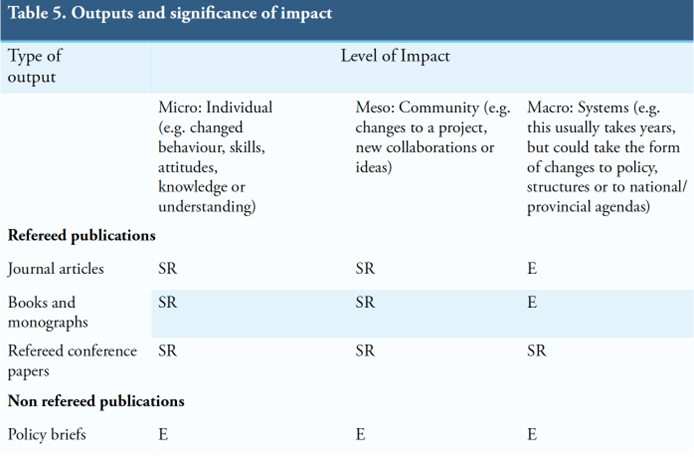
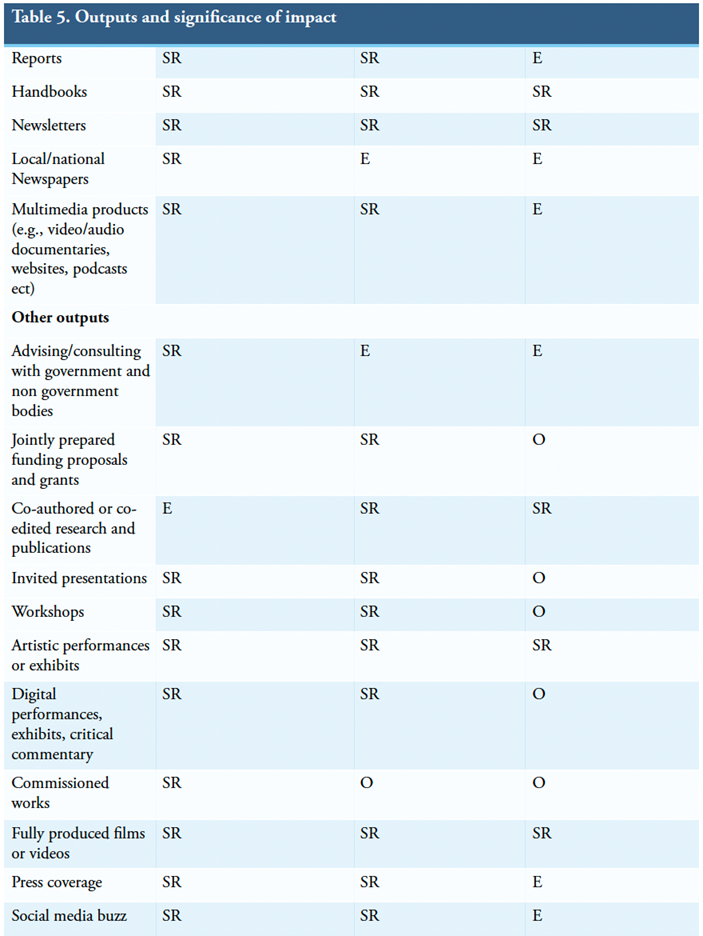
Promotion Dossier. The dossier should include a community-engaged scholarship statement from the faculty member and any supplementary material(s) from the faculty member that describes impact, processes, and products of engagement:
- The community-engaged scholarship statement should clearly describe the goals and process of the scholarship, along with the impact on the community at the specified level and the impact to the home discipline, related disciplines, and/or the scholarship of engagement.
- While a traditional teaching or research statement may include mention of engaged work, the goal of an additional statement is to explain how the faculty member’s processes align with community engagement best practices; to describe community and societal impact (not just impact on the field of study or on students); and to address integration of research with teaching in the form of student mentorship or community-engaged learning.
- Supplementary materials in addition to the scholarship statement may include:
- A letter of support from a community partner that describes local impact
- A letter of support from experts in engaged scholarship uninvolved with the faculty member’s work, from within or outside of academia, that describe impact on the social issue or the field of engaged scholarship
- Up to three pieces documenting community or societal impact that are not publications within the field of study, such as policies contributed to, public scholarship, or evidence of community presentations or impact on the practices of community organizations
- External Reviewers. All reviewers should be willing to consider best practices in assessing engaged scholarship. External reviewers who may not be experts in community-engaged scholarship should be instructed to consider that, for this candidate, impact is also defined in relation to the population, place, or community as well as impact on the scholarly conversation or field of research (Addendum to external review letter).
- If a substantial proportion of the faculty member’s work includes community-engaged scholarship: At least one reviewer should have demonstrated expertise in community engagement.
- If the faculty member’s work is primarily traditional scholarship with some engaged scholarship: An additional letter writer who is an expert in community-engaged scholarship could be added to the reviewers to supplement the expertise of disciplinary experts.
Note: If a faculty member who has completed the memorandum of understanding decides not to submit the statement on community-engaged scholarship that decision must be made by the time the faculty member submits a list of external reviewers.
Assessing Community-Engaged Teaching in Promotion and Tenure Review
Community-Engaged Teaching in the Review Process
Faculty members for whom a large proportion of their teaching is classified as community engaged may elect to have that work assessed according to engagement best practices. Relevant background sections of this document include:
- Community Engagement: An Introduction
- Best Practices in Review of Community-Engaged Scholarship and Teaching
This document provides a timeline and template for how the faculty review process can include community-engaged teaching.
Faculty members considering whether to have their teaching, assessed as community-engaged scholarship should consider the following (adapted from the University of Illinois Public Engagement Research Option); faculty members answering yes to most of these points may benefit from alternative assessment of community-engaged scholarship:
Engaged teaching is a substantial proportion of your portfolio over time, vs. a single project.
Your community-engaged teaching includes in-depth collaboration with community or other public partners—for example, the partner is involved in developing the project, meeting with students, and assessing outcomes.
The work requires significant relationship-building with community partners.
The work has a definable impact on the community at the local, state, national, or international level.
The work is done in a way that the community can continue the program and/or policy developed by the work; the impact of the work can be sustained.
For Faculty Seeking Promotion Based on a Record of Community-Engaged Teaching
Impact and Assessment of Community-Engaged Teaching: Community-engaged teaching describes the creation of sustained, mutually beneficial partnerships that go beyond direct service (e.g., cleaning up a community garden or tutoring youth) to offer value to community partners, deepen students’ academic and civic learning, and provide opportunities for student reflection.
Community-engaged teaching may be assessed through evidence of these best practices:
- Sustained relationships with community partners
- Clear goals for the partnership, developed in collaboration with community partners
- Products of benefit to community partners, such as projects, reports, events, videos, artwork, oral history recordings, etc.
- Community partnership integrated into the syllabus and class learning goals
- Meaningful relationship between the community engagement project and student academic and civic learning
- Opportunities for students to build core competencies like professional communication, critical thinking, working across differences and application of technical skills and knowledge.
- Opportunities for critical reflection by students during the learning process
Promotion Dossier. The dossier should include a community-engaged scholarship statement from the faculty member and any supplementary material(s) from the faculty member that describes impact, processes, and products of engaged teaching:
- The community-engaged scholarship statement should clearly describe the goals and process of community-engaged teaching, along with the impact on the community at the specified level as well as impact to student learning.
- While a traditional teaching statement may include mention of engaged work, the goal of an additional statement is to explain how the faculty member’s processes align with community engagement best practices; to describe community impact (not just impact on students); and to address any integration of research or creative activity with teaching in the form of student mentorship or community-engaged learning.
- Statements emphasizing community-engaged teaching and learning should also consider reflecting on how the work aligns with these best practices:
- Sustained relationships with community partners
- Clear goals for the partnership, developed in collaboration with community partners
- Products of benefit to community partners, such as projects, reports, events, videos, artwork, oral history recordings, etc.
- Community partnership integrated into the syllabus and class learning goals
- Meaningful relationship between the community engagement project and student academic and civic learning
- Opportunities for students to build core competencies like professional communication, critical thinking, working across differences and application of technical skills and knowledge
- Opportunities for critical reflection by students during the learning process
- Supplementary materials in addition to the scholarship statement may include:
- A letter of support from a community partner that describes local impact
- Up to three pieces documenting community or societal impact that were outcomes from community-engaged teaching, such as policies contributed to, public artworks, plans developed for communities, evidence of community presentations or impact on the practices of community organizations.
Memorandum of Understanding for Community-Engaged Scholarship Review
This document outlines an agreement between a faculty member and their DEO to establish expectations and evaluation standards for community-engaged scholarship in the faculty review process. It specifies how such work will be documented, assessed, and reviewed, including the use of supplementary materials and reviewers with relevant expertise.
Memorandum of Understanding for Community-Engaged Scholarship Review (PDF)
Sample Addendum to External Review Letter for Community-Engaged Scholarship
An addendum guiding external reviewers to evaluate the candidate’s community-engaged scholarship using both scholarly and community impact measures.
Sample Addendum:
The University of Iowa values community-engaged scholarship for research, teaching, and service. Faculty for whom a significant proportion of their scholarly or creative work is community engaged may submit a community-engaged scholarship statement and supplementary materials to document the goals, process, and impact of their engaged work. These materials may include products whose impact is not captured by traditional metrics, such as policy reports, public scholarship, and exhibits or community presentations. Because this faculty member has selected to include the community-engaged scholarship statement and supplementary materials, their dossier may differ from those typical in your field. These materials are not merely addenda to the research program of this candidate but key indicators of the impact of their engaged scholarship. Consideration of non-traditional metrics may be required to fairly assess the impact of this community-engaged scholarship. Please carefully consider these materials in your evaluation and assess both the scholarly significance of the work to your field as well as the significance to local community collaborators, to society, to the scholarship or engagement, and/or to interdisciplinary scholarship related to the social issue or problem.